Real Estate
First-time Home Buyers: Fake Real Estate Narratives
Jonathan Lonsdale
4 min
NAR says the median first-time home buyer is now 40. Loan records, the NY Fed, and the Census Bureau put it in the early 30s, where it has been for decades.
I recently bought a house at 39 years old. This felt old for my cohort, but NAR data said the median age of first-time home buyers is 40. As Jeff Bezos said, “When the data and the anecdotes disagree, the anecdotes are usually right.” We can find the data to tell any story. The question is, what’s true and what does it mean? Let’s look at the data.

The National Association of Realtors’ bad data
First-time Home Buyers
From 1981 to 2011, the age of first-timers rose by only two years, from 29 to 31, less than the four-year rise in the median age at first marriage. The narrative is that the age of first-time homebuyers drastically increased after 2021. I did some research:
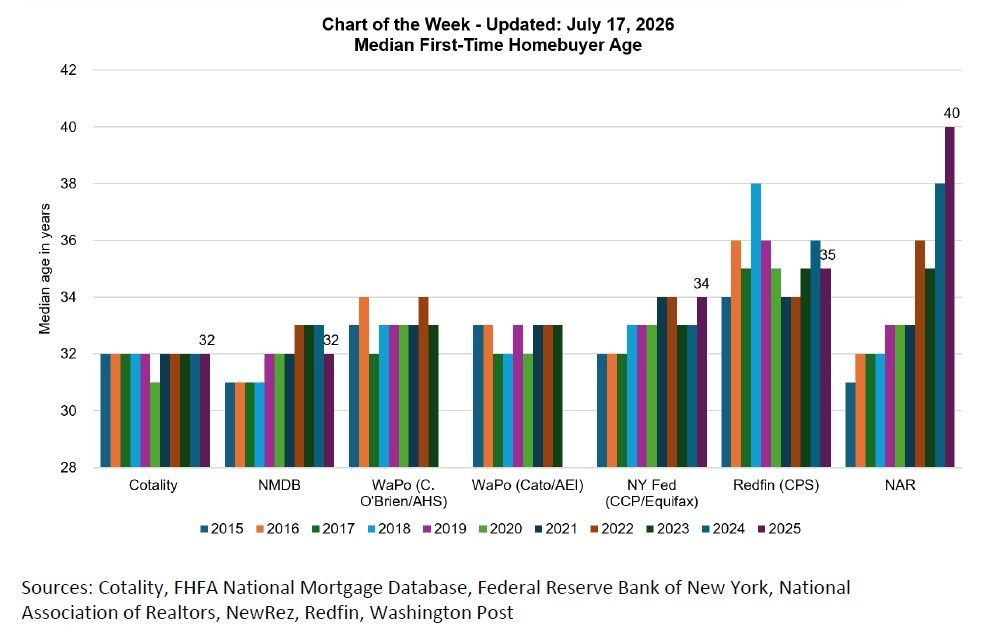
The National Association of Realtors’ (NAR’s) latest “Profile of Home Buyers and Sellers” puts the median age of first-time buyers at 40 in 2025, up from the late 20s in the 1980s.
AEI Housing Center analyzed millions of anonymized loan records, using HMDA and agency MBS loan-level data. They found that the age distribution of first-time buyers by cohort remained stable from 2018–2024, with a median within the 25–34 band every year.
The NY Fed includes only buyers who take out a purchase mortgage and have a credit file. It excludes all-cash buyers and non-traditional financing. The median was 33 in 2024, 34 in 2025, and 33 in mid-2026.
When looking closer, the NAR data is a 120-question mailed survey of recent home purchasers. The 2025 survey had 6,103 responses out of 173K questionnaires mailed (a 3.5% response rate). Young adults are less likely to respond to a survey than middle-aged and older adults. Compared with credit bureau data, NAR’s sample underrepresents first-time buyers under 35 by 17%. NAR’s methodology is the most unreliable of the three and contradicts the other two the most.
NAR’s own long-term data showed the median first-timer age was stable around 30–32 for decades (even dropping to 30 after the late-2000s recession). NAR’s sudden spike from age 33 in 2021 to 40 in 2025 is unprecedented. If the typical first-timer were really 40, homeownership among adults under 35 would have collapsed. It was 35.2% in mid-2026, close to 37.4% in 1994.
Source: MBA
The Census Bureau’s American Housing Survey first deviated from NAR’s data in 2022. AHS remained at 33 through 2023, its latest survey, and NAR jumped to 36. NAR’s defense is that mortgage data miss first-timers who pay cash, about 8% of them. The AHS and Redfin’s analysis of Census data count cash buyers and still land at 33 and 35. Zillow’s survey also contradicts NAR’s results, putting first-timers at 44% of 2024 buyers versus NAR’s 24%. Given this, it’s clear the first-time home buyer’s age hasn’t spiked, but let’s look outside the US.
International First-Time Homeownership
In England, the average first-time buyer is around 34 years old (up from about 29 in the early 1980s). In Canada, the average is around 36.
Some nations skew younger. Belgium’s first-time buyers average in their late 20s. Switzerland is an outlier with high housing costs and stringent down-payment requirements. The average Swiss first-time buyer is 48, and homeownership is rare among young adults.
The US norm of early-30s for first-home purchase aligns with other developed countries, and there’s no global pattern of a sudden age surge.
Cultural Pressure
In cultures like China, homeownership is widely seen as a prerequisite for marriage. It’s required for a later phase of life, regardless of whether it makes financial sense.
In the U.S., while less extreme, a strong preference remains for owning a home when settling down. These factors reinforce why American first-time buyers continue to enter homeownership around the time of marriage.
Many buy in their late 20s to early 30s, even if it means stretching their finances or getting help from parents.
What Does This Mean?
NAR data has been completely off since 2022 and has only gotten worse. NAR also says the share of purchases by first-timers fell to a record low of 21%. Other data say otherwise. Even NAR’s own monthly survey of Realtors put first-timers at 30% of existing-home sales in August 2026. NY Fed and American Housing Survey data say first-time buyers are a third or more of all home buyers. The Urban Institute puts first-timers at about 54% of Fannie Mae, Freddie Mac, and VA purchase loans and about 80% of FHA loans. Those agency numbers only count financed purchases and treat anyone who hasn’t owned a home in three years as a first-timer, so they run high.
Is this good or bad? It’s neither. There’s more optionality with renting. Buying may not always be the best use of capital, especially with mortgage rates above 7%.
So, the first-time homebuyer’s age hasn’t increased drastically in the last 20 years, nor has their share drastically decreased. It’s another false real estate narrative we’ve been told. But it doesn’t mean there isn’t action to be taken. The cost of real estate and, thus, the cost of living remains artificially inflated due to poor policy decisions.
More Articles